Cleanup in Aisle One
Hy-Vee created "reimagined" grocery stores. Now, the company is getting back to some of the basics that made it successful.

The movie “A Man Called Otto” introduces Tom Hanks as Otto, shopping in a hardware store. Otto, a cranky, old sourpuss, chastises a store employee who simply tries to help him.
He then accuses a cashier of overcharging him by pennies and brushes off a customer who offers to pay the difference. Finally, Otto belittles a young female store supervisor by asking her, “Shouldn’t you be in gym class?”
That’s Otto, an engineer recently nudged into retirement who now sneers and snorts through what’s left of his life, complaining about all the idiots in his world. “Idiots!”
Not a great movie, but the Otto character did hit home with me. Lately, I’m seeing more Otto in myself. I’m an old man now and I confess to taking on some of Otto’s grumpiness when I go shopping — especially in grocery stores.
It’s a troubling new life stage for me because I’ve long had an affinity for supermarkets. My first job was as a teenager in the late 1960s and early ’70s. I earned my first paycheck as a part-timer at a small Hy-Vee store in Marion, Iowa.
Hy-Vee’s slogan was, and remains today, “A helpful smile in every aisle.” And it was no laughing matter. All employees were expected to help customers with any need — and to do so politely with pleasant, sincere smiles.
Meet the “Courtesy Boys”
High school guys like me were called “courtesy boys.” We unloaded trucks, stocked shelves, sacked groceries, loaded the bags into shopping carts and then out to the customers’ cars in the parking lot. Our dress code required clean slacks, a crisp dress shirt and a necktie — often a cheap clip-on model.
The ensemble was completed with a white, knee-length apron, and a belt holster armed with an inked price stamper. The task of stocking shelves went like this: With a box cutter, you’d slice the top off a cardboard box of, say, canned peaches. Then, you’d ink up the price stamper and “ka-chunk, ka-chunk, ka-chunk” stamp the top of each can with the price, in ink. Finish the job by neatly stacking each can in the store shelves, product labels facing out.
Yes, girls worked there, too. They were called “checkers” and they operated the cash registers up front.
I have fond memories of those days. Starting at $1.60 per hour, courtesy boys learned the value of hard work and a dollar. The wages helped me buy a used Pontiac GTO and the petrol to fuel that gas-guzzler.
We acquired social skills and made lifetime friends. Some high school chums even chose to stay with Hy-Vee as a career. They made good money as they advanced in management and retired quite comfortably at an early age. Me? Alas, I chose journalism. Idiot!
Later, as a customer, I continued to enjoy exploring the aisles of a supermarket, pushing a cart past the freezers, meat counters, produce bins, and bakeries.
The Thrill is Gone
Now? Not so much. Modern grocery stores are testing my limits. Especially at my long-ago employer, Hy-Vee. The biggest grocery chain in Iowa, it is also one of the fastest growing in the nation. It recently was named the No. 1 grocery store in America by USA Today, Hy-Vee noted.
Still, as the once down-homey company grew steadily over the years, it was not always for the better, in my opinion.
In my visits to local stores, I found workers in the aisles were busy stocking shelves. They seemed to avert eye contact, let alone risk a helpful smile. It was the same at the front of the stores, where many of the employee-operated checkout counters were empty. Empty and closed. Customers were increasingly asked to ring up their own purchases — at self-checkout counters equipped with barcode scanners — and bag and carry or cart out the groceries to their cars.
To be fair, Hy-Vee has had to contend with worker shortages like much of corporate America since the darkest days of the Covid pandemic. Still, it’s hard for me to reconcile this fend-for-yourself trend with a company that boasts such a long and revered history of service to its customers.
Hy-Vee is an employee-owned business and its roots in Iowa are deep. In 1930 Charles Hyde and David Vredenburg opened a small store in tiny Beaconsfield, Iowa. Their last names formed the “Hy” and the “Vee” of the Hy-Vee company name, and their stated goal was to provide “good merchandise, appreciative service and low prices.”
This modest start evolved into what has become the largest private employer in Iowa. To its credit, Hy-Vee has hired thousands of high school and college kids like I was. The company now says it has about 30,000 employees in Iowa and about 70,000 all told.
In 1995 the company moved its headquarters to West Des Moines, a fast-growing suburb in the center of the state, from Chariton, which was Hy-Vee’s corporate home in sleepy southern Iowa since 1945.
Today, with sales of $13 billion per year, employee-owned Hy-Vee is stretching its footprint eastward, to Indiana. In April 2024 Hy-Vee acquired the Strack & Van Til Food Market chain, which has stores throughout northwest Indiana.
That added 22 stores to Hy-Vee’s more than 550 retail business units, which include “grocery stores, drugstores, pharmacies, restaurants and convenience stores that focus on meal solutions for busy families,” Hy-Vee told me in an email Thursday.
Already in a presence in Midwest states, the grocer also has designs on entering Tennessee, Alabama and Kentucky. Hy-Vee says it has not yet announced construction plans for these states.
A Company on the Move
Some Iowans (including me) and industry analysts worried that Hy-Vee was losing its way — that its vision had been blurred by an appetite for geographic growth, technology, social media, and megastores with too many non-food categories such as shoes and clothing. Also curious was the company’s affection for show-business hipsterism and celebrity partnerships.
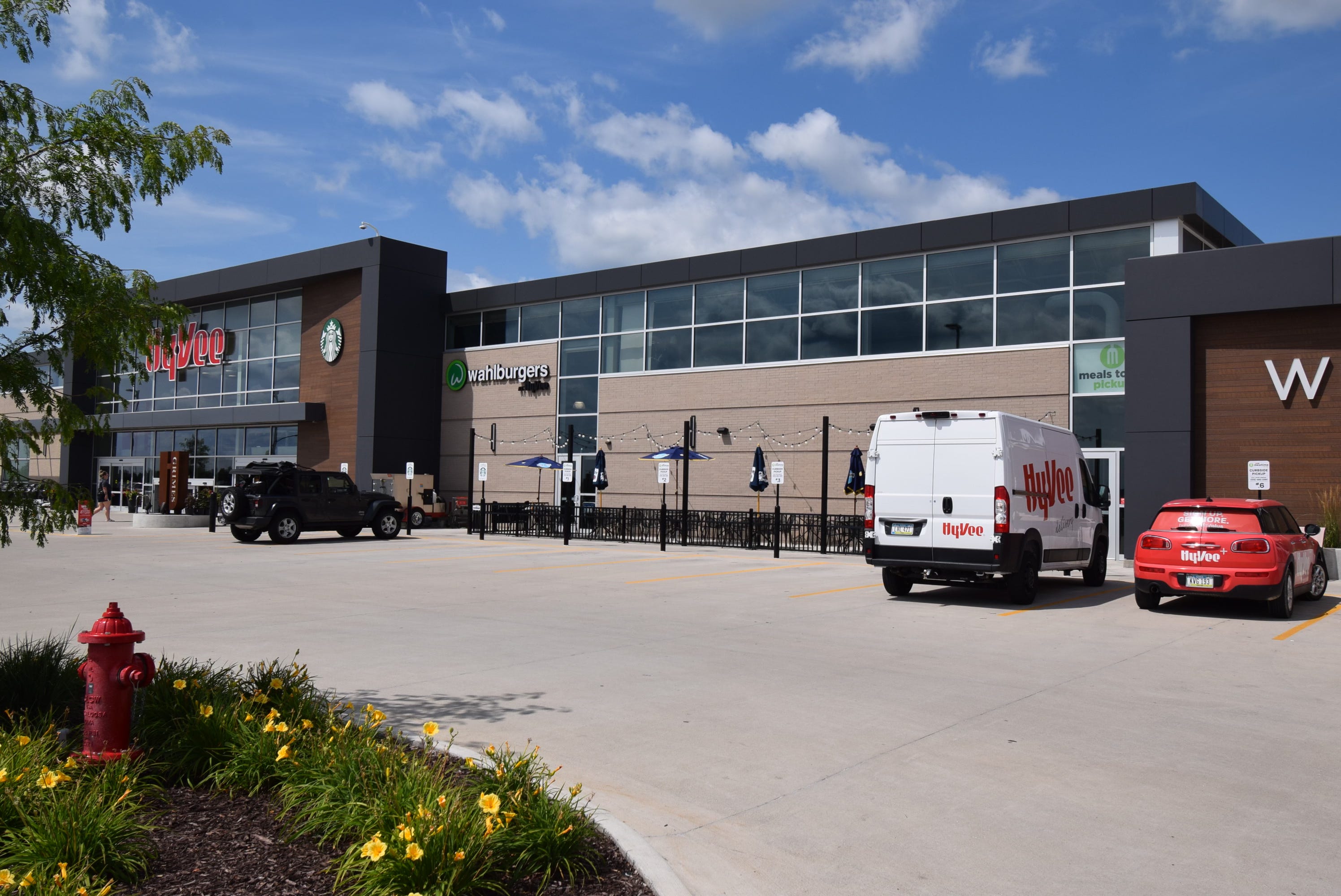
The look, vibe and scope of newly opened Hy-Vee stores changed. In late 2021 Hy-Vee, with much fanfare, opened the doors to what it termed its “first entirely reimagined grocery store,” in the Des Moines suburb of Grimes. This 93,000-square-foot behemoth represented the dreadnought of Hy-Vee’s fresh fleet of supermarkets.
Hungry? Graze in the store’s large, open food hall for fast-casual dining. Enjoy: the pub with full bar and outdoor patio; made-to-order meals from Mia Italian, HyChi, Nori Sushi, Long Island Deli; and an in-store Wahlburgers restaurant (more on that in a bit).
Got a fashion itch? Step this way and browse the DSW shoes and accessories, the Joe Fresh clothing, and the well-stocked beauty department. For the store’s opening there was even a nail salon as part of a multi-store partnership with The W Nail Bar.
Want to get physical? Check out the fitness and wellness showroom with treadmills and other workout equipment.
Working up a thirst? The well-stocked wine and spirits department includes a walk-in beer cooler, cigar humidor, and showcase wine room that displayed a humongous bottle of premium champagne at a price of $1,600.
Sweet tooth? There’s a candy section so vast it could give Willy Wonka a sugar rush.
All of this is not to suggest you won’t also find essential groceries galore at this reimagined Hy-Vee grocery store. They’re displayed with eye-catching digital shelf labels that explain product information and pricing, along with more than 100 TVs featuring Hy-Vee products, promotions and services.
Hooray for Hollywood
As for the Wahlburgers restaurant, it’s perhaps the highest-profile illustration of Hy-Vee's acquired taste for celebrity partnerships and endorsements.
Wahlburgers was launched on the East Coast by chef Paul Wahlberg along with his famous show-business brothers Mark and Donnie Wahlberg. In 2017 Wahlburgers and Hy-Vee reached a deal in which the grocery store company would build, own and operate the burger shops in several states.
Mark Wahlberg, in fact, made numerous appearances at Hy-Vee events in the Des Moines area. In summer 2022, on a sweltering Sunday afternoon at a race track in Newton, Wahlberg raised a microphone to his lips and barked: “Drivers! Start your engines!” With that, 26 turbocharged Indy Car race cars thundered to life. Some 30,000 sweaty race fans joined the cacophony. They rose from their grandstand seats and cheered the start of the Hy-Vee Salute to Farmers 300 auto race.
It was the second of two Indy Car races during a Saturday-Sunday doubleheader on the sun-baked asphalt Iowa Speedway track in Newton, about a half-hour’s drive from Des Moines. The weekend also treated spectators to trackside concerts by star entertainers Tim McGraw, Florida George Line, Gwen Stefani and Blake Shelton.
Hy-Vee also sped into the digital and social media world, with bold entertainment and marketing ventures. The grocer launched HSTV, a streaming network chock-full of all-new online video content. Viewers could browse dozens of videos on cooking, bartending, entertaining and fashion.
Strangers in the Night
“Always bingeable,” a banner proclaimed on HSTV.
“Always cringeable” might be a more apt description of “Love at First Bite”, an original reality dating series launched in 2022 on HSTV. The premise: Two strangers meet for a “date” in the grocery store and shop for dinner ingredients handed them by a super chef. Then the couple retreats to a home kitchen to prepare dinner together, chat it up and, well, let’s just see if romance ensues, shall we? Spoiler alert: It did not, based on my viewing of eight episodes.
Better head-spinning drama came out of the Hy-Vee board room.
In July 2022 Randy Edeker said he was stepping down as the company’s chief executive officer. Vice-chairman Aaron Wiese would succeed him, the company said, while Edeker would remain chairman of the board.
Weeks later, the company announced Jeremy Gosch would be named “co-CEO” with Wiese. Edeker explained that the job had become too large for just one person.
That plan didn’t last long. Months later, Hy-Vee announced Gosch would become the sole CEO, with Wiese and two other executives reporting to Gosch.
Did you get all that? Because I’m sure the eyeballs of Hy-Vee’s founders would be rolling in their graves.
For a company with humble origins, I wonder what the founders would think of Hy-Vee’s splashy promotions, including marketing partnerships with NFL quarterback Patrick Mahomes and the ubiquitous basketball star Caitlin Clark, among others.
The company sponsored an Indy car team, and it brought the Indy car race weekend back in 2023 and 2024, along with headliner concerts by Carrie Underwood and others.
Credited with investing millions in upgrading the Newton raceway and in attracting concert entertainers, Hy-Vee undoubtedly pumped much-needed life into the track — which has sputtered with a start-and-stop history — and the city of Newton.
Enough Already!
A good civic deed, indeed. But race cars. Celebrities. Streaming reality shows. Shoes. Sweaters. Toenails. Hipster casual dining. As former President Joe Biden used to say, “C’mon man!”
Two years ago, Brittain Ladd, an industry consultant in Dallas, said to me in a phone interview: “Is it time we scaled back on some of this stuff? At the end of the day, Hy-Vee will live or die on its ability to sell groceries.”
Now, there are signs that Hy-Vee is doing just that:
Current TV commercials feature store directors who earnestly inform viewers that Hy-Vee is doing its level best to keep prices affordable in these trying times.
Last October the company said it would no longer sponsor a racing team in the NTT IndyCar Series. It also said it was ending its sponsorship of the IndyCar race at The Milwaukee Mile this season.
Last month, Hy-Vee announced it will not be the title sponsor at this year’s Indy race in Newton, though it will still have a sponsorship role. “We are focusing on further being involved in our local communities where our customers and employees live, work and play,” Hy-Vee’s email said. These events include: a Grimes Multiplex where families will gather for sporting events; sponsorship of a new event center and amphitheater in North Liberty; premiere sponsorship of the Cedar Rapids Freedom Festival; and an expanded presence at the Iowa State Fair.
Hy-Vee said it is removing self-checkouts at some stores. “We want to provide a better customer experience in several of our stores by bringing back the face-to-face interaction with our employees that we had pre-Covid,” Hy-Vee told me in its email. “Retailers like Target and Walmart have already been removing self-checkouts across the country for several months, so we are not the first to do this.”
The company’s content on HSTV is now more sharply focused on food and beverages. “Love at First Bite”, the reality dating show, bit the dust. Hy-Vee did not address that show directly with me, but did share some newsy developments: Its print magazine, Hy-Vee Seasons, will transition to an all-digital content platform on Hy-Vee.com and on the Hy-Vee app to “create a more engaging user experience.” There’s more. The company is rebranding its HSTV channel as Seasons TV and “integrating the digital Hy-Vee Seasons experience, allowing users to read articles, search recipes, shop content, watch how-to videos and stream programming all in one place.”
And the reimagined grocery stores? At the sprawling Grimes supermarket, the nail salon is gone. Gone, too, are exercise equipment, the shelves of W shoes and the racks of Joe Cool clothing — all swept away and replaced by stacks of on-sale items, from Cheetos to Oreos.
Hy-Vee explained in the email: “Hy-Vee has always been innovative and is not afraid to try new things. Some of those partnerships work and others do not. We are not afraid to pivot when/if need be.”
Wahlburgers, We Hardly Knew Ye
Notably, Wahlburgers had vanished from the store. Hy-Vee announced Jan. 20 that it will “transition” all in-store restaurants to its Market Grille concept, ending its partnership with Wahlburgers.
Early on, the relationship created a burst of buzz for Hy-Vee and an easy growth stimulus for Wahlburgers.
Still, “it was an odd pairing to begin with,” Jonathan Maze wrote in Restaurant Business. “The fact of the matter is, customers don’t go to the grocery store to enjoy a nice meal. They are generally there to buy food” to take home, or to work for lunch.
Joe Guszkowski, an editor at Restaurant Business, reported Wahlburgers CEO Randy Sharpe as saying Wahlburgers “was not happy with the performance of the Hy-Vee-operated locations.”
My hunch is the feeling was mutual at Hy-Vee headquarters. That suspicion was confirmed — and then some — by Hy-Vee. “We were the first to make the decision to transition back to Hy-Vee Market Grille locations and we notified Wahlburgers about our decision. It was not the other way around,” Tina Potthoff, Hy-Vee’s senior vice president, communications, told me in the email.
She said the return to Market Grilles was a result of feedback from Hy-Vee’s customers. The new Market Grilles are open with new hours for breakfast, lunch and dinner, and refreshed menus.
A personal tidbit: I recently ate lunch at the Market Grille in the Grimes Hy-Vee. It was a typical Iowa pork tenderloin sandwich, with the breaded and fried meat about the size of a dinner plate, far surpassing the size of the buns. I don’t think this sandwich poses a threat to win the Iowa Pork Producer Association’s best-loin contest. But it was edible and affordable: $8.51 for the sandwich, fries and a medium lemonade.
I took a look at the menu for the Wahlburgers restaurant at the hulking Mall of America in the Twin Cities — which the Wahlburgers chain will continue to operate. There was no pork tenderloin sandwich — it’s more of an Iowa thing, after all. But for comparison’s sake, the cost of a Crispy Chicken Ranch sandwich, fries and a fountain soda came to $13.99 at Wahlburgers.
Price Points
To be sure, Hy-Vee now seems to be taking more of a stay-in-your-lane approach. Price — amid the nation’s hue and cry over rising food costs — is the talking point now. Dozens of banners and signs outside at the store announce “new lower prices on thousands of items.”
“In today’s economy,” Potthoff wrote, “it is important for customers to know that we are extremely focused on bringing them the best value, which is why we worked with our suppliers to lower prices on thousands of items.”
This laser focus on price was a national trend among traditional grocers last year as they battle competition from the likes of Costco. Look for it to continue this year.
“They’re going to be hyper-focused on getting price right, getting promotions right, promoting the right things, and, most importantly, having those touch points with [their] shopper so they continue to come back,” Matt O’Grady, president of the Americas for retail analytics firm Dunnhumby, told the Grocery Dive website.
Ladd, the Texas consultant, applauds the stick-to-your-knitting approach. “Hy-Vee is getting back to what made them successful: Providing value.” That means friendly service, competitive prices, and quality groceries for a great customer experience, he said.
“That’s what really made Hy-Vee,” he argued. “They didn’t become who they are because they sponsored this or were in the media that.”
It was time for a cleanup in the aisles.
Time to reimagine the reimagined grocery store.
Biz Whispers is a reader-supported publication. If you’d like to receive new posts and support my work, consider becoming a free or paid subscriber.
This column is part of a fast-growing collection of reporting and writing from Iowa writers all over the map. You owe it to yourself to check out their work at Iowa Writers' Collaborative. From politics to entertainment, from food to music, and from the media to rural affairs — and now, Iowa business.
I forgot what an amazing talented writer you are. Really well written and informative
I quit shopping at Hy-Vee when they closed low-profit stores in Waterloo and Cedar Rapids, leaving those areas of the cities food deserts. Taking care of customers counts beyond the aisles, too.